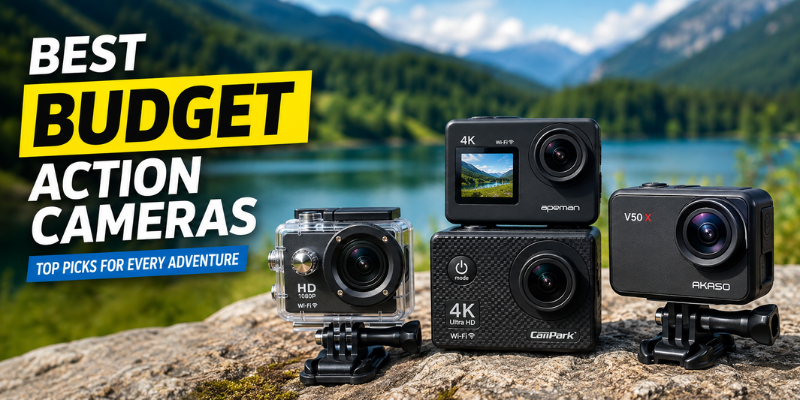
Action cameras have a way of making ordinary moments look far more exciting. A weekend bike ride, a family trip, a hike through the hills, or a day at the beach can all become memorable footage when you have a small camera that can handle movement and weather. The good news is that you no longer need to spend flagship-camera money to get useful video quality. The best budget action cameras now offer 4K recording, electronic stabilization, compact designs, and surprisingly capable accessories. The real challenge is finding the model that gives you the features you will actually use.
What Makes the Best Budget Action Cameras Worth Buying?
The cheapest action camera is not automatically the best value. A low-priced model may advertise 4K video, but resolution alone does not tell you how good the footage will look while cycling down a rough road or walking through a dimly lit street.
For most buyers, the important factors are stabilization, image quality, battery performance, waterproofing, ease of use, and the quality of the included mounting system.
A camera that costs slightly more but produces stable footage and survives rain can be a much better purchase than an ultra-cheap model that spends most of its time sitting in a drawer.
Current action-camera guides continue to highlight affordable options from brands such as DJI, GoPro, AKASO, and Insta360, with older premium models often becoming particularly attractive when their prices fall.
DJI Osmo Action 4: A Strong Value Choice
If you find the DJI Osmo Action 4 at a discounted price, it is one of the most interesting choices for buyers who want near-premium performance without paying for the newest flagship.
Its 1/1.3-inch sensor, 4K recording at up to 120fps, RockSteady 3.0 stabilization, and dual touchscreens give it a feature set that remains impressive. DJI also rates it for waterproofing to 18 meters without the waterproof case.
The larger sensor is especially useful when the light starts disappearing. That matters if you regularly record early-morning rides, evening walks, camping trips, or indoor activities.
Another practical advantage is stabilization. DJI’s RockSteady system is designed to compensate for camera movement, while HorizonSteady can keep the horizon level during more aggressive movement.
For someone who wants one camera for travel, cycling, family adventures, and occasional underwater footage, the Action 4 is difficult to ignore when discounted.
GoPro Models Still Make Sense on a Budget
GoPro remains one of the safest names in the action-camera market because its accessories, mounts, software ecosystem, and overall shooting experience are well established.
The trick for budget buyers is not necessarily chasing the newest GoPro. An older generation or simpler HERO model can offer plenty of performance for casual users, especially if you do not need advanced professional recording modes.
GoPro’s biggest strength is versatility. Helmet mounts, chest mounts, suction mounts, mini tripods, and countless third-party accessories make it easy to position the camera almost anywhere.
For a beginner, that ecosystem can be more valuable than a small difference in image quality.
If your main activities involve hiking, cycling, skiing, road trips, or family vacations, a discounted GoPro can be a sensible long-term purchase rather than buying the cheapest unfamiliar camera available.
AKASO: Where Budget Buyers Get the Most for Their Money
AKASO has built a reputation around affordable action cameras, and its Brave series is worth considering when keeping the purchase price low is the main priority.
The appeal is straightforward: you can get features such as 4K recording, dual-screen designs, waterproof housings, and multiple accessories without moving into premium-camera pricing. Current 2026 buying guides continue to identify the AKASO Brave range as one of the more attractive options for shoppers who want an inexpensive action camera.
There is a trade-off, however.
Budget models generally cannot match the best DJI or GoPro cameras in areas such as low-light image quality, stabilization refinement, color consistency, and overall processing.
That does not make them bad cameras. It simply means they make more sense for specific users.
If you are buying your first action camera for occasional vacations, children’s activities, casual cycling, or experimenting with YouTube videos, an AKASO can be a very reasonable starting point.
Insta360 GO 3S Is Different From a Traditional Action Camera
The Insta360 GO 3S deserves attention because it approaches the action-camera idea from another direction.
Instead of being a conventional box-shaped camera designed primarily for helmet or handlebar mounting, the GO 3S is an extremely small camera designed around hands-free shooting. The camera itself weighs only about 39 grams, while its Action Pod adds a larger screen and controls.
It can record 4K video at up to 30fps and uses FlowState stabilization with Horizon Lock. The camera is also waterproof to 10 meters when the required Lens Guard is installed.
This makes it particularly interesting for creators.
Imagine walking through a market while recording a hands-free point-of-view shot, mounting a tiny camera to a backpack strap, or filming a cooking demonstration without having a large camera attached to your chest. Those are situations where the GO 3S can be more convenient than a traditional action camera.
Its small size is its biggest advantage—and also the reason it is not the perfect choice for everyone.
The Features That Matter Most on a Budget
Before buying, focus on the features that affect your actual shooting rather than the biggest number printed on the box.
Stabilization:
This is one of the first things to check. A sharp 4K video becomes difficult to watch when every bump and vibration is visible.
Real 4K performance:
Look beyond the words “4K action camera.” Check the frame rates, stabilization limitations, bitrate, and available shooting modes.
Low-light performance:
Small sensors struggle as light falls. If you often shoot at sunset or indoors, sensor size and image processing can matter more than maximum resolution.
Water resistance:
Do not assume that every camera advertised as waterproof can be submerged indefinitely. Check the manufacturer’s depth rating and whether a case is required.
Battery life:
Manufacturers normally measure battery performance under specific laboratory conditions. Your real-world result can be shorter when using high resolutions, stabilization, bright screens, Wi-Fi, or cold-weather shooting.
Mounting options:
A camera becomes much more useful when you can mount it securely. Before buying, check what comes in the box and how easily compatible accessories are available.
How to Choose the Right Camera for Your Use
For travel, look for a balance of stabilization, battery life, waterproofing, and easy file transfer. A camera that is simple to operate is often more useful than one packed with advanced settings you never touch.
For cycling and motorcycling, stabilization becomes a priority. Handlebar vibrations can quickly expose weak electronic image stabilization, so this is an area where spending slightly more can make a noticeable difference.
For vlogging, consider front-facing screens, microphone options, voice controls, and the camera’s ability to produce clean footage while you are talking directly to the lens.
For water sports, waterproofing deserves careful attention. The DJI Osmo Action 4, for example, is officially rated to 18 meters without a case, while the Insta360 GO 3S camera is rated to 10 meters with its Lens Guard installed.
For casual family use, you may not need premium specifications at all. An affordable AKASO or discounted GoPro can make more sense if you only plan to record occasional trips and outdoor activities.
Do You Really Need 4K?
For most buyers, 4K is useful—but it should not be the only reason to choose a camera.
4K gives you more detail and provides additional flexibility when cropping footage. It is particularly useful for travel videos, YouTube content, and clips that may be viewed on larger screens.
However, a well-stabilized 1080p or 2.7K clip can look much better than shaky, poorly exposed 4K footage.
The DJI Osmo Action 4, for example, can record 4K at several frame rates and up to 120fps, giving users flexibility for both normal footage and slow-motion scenes.
A practical approach is to shoot 4K/30fps for everyday scenes, use 4K/60fps when there is lots of movement, and reserve higher frame rates for situations where slow motion is genuinely useful.
Small Accessories Can Improve Your Footage
Once you have selected a camera, do not spend every remaining dollar on another specification upgrade.
A few inexpensive accessories can have a bigger effect on the final footage.
A spare battery is useful for long days outdoors. A fast microSD card prevents recording problems. A chest or helmet mount can create more engaging perspectives, while a small grip or tripod makes stationary recording easier.
A basic protective case and lens protector are also worth considering if you frequently use the camera around sand, dust, rocks, or salt water.
The goal is simple: build a setup that makes the camera easier to use rather than filling your bag with accessories you rarely need.
Best Budget Action Cameras: Which One Should You Buy?
There is no single winner for every person.
The DJI Osmo Action 4 is a particularly strong value option when discounted, especially for users who care about stabilization, low-light performance, waterproofing, and high-frame-rate 4K.
A discounted GoPro is attractive for buyers who want a mature accessory ecosystem and a familiar action-camera experience.
An AKASO Brave model makes sense for shoppers who want to keep the initial cost down while still getting modern action-camera features.
The Insta360 GO 3S is the more unusual choice. Its tiny body and hands-free design make it appealing to vloggers and creators who want perspectives that a conventional action camera cannot easily provide.
The smartest purchase is therefore not necessarily the camera with the longest specification sheet. It is the one that fits the way you actually record.
Frequently Asked Questions
Are budget action cameras worth buying?
Yes. Budget action cameras have become considerably more capable, particularly for daylight recording, travel, cycling, and casual outdoor use. The main compromises usually appear in low-light quality, stabilization, audio, software, and long-term support.
What is the best budget action camera for beginners?
A discounted DJI Osmo Action 4 is an excellent option if your budget allows it, while an AKASO model can be a better fit when keeping the purchase price as low as possible. Beginners should prioritize ease of use and stabilization over advanced professional features.
Is 4K necessary for an action camera?
No, but it is useful. 4K gives you more detail and cropping flexibility, while 1080p and 2.7K can still produce perfectly good footage. Good lighting and stabilization often matter more than resolution alone.
Can budget action cameras be used underwater?
Many can, but waterproof ratings vary significantly. Always check the manufacturer’s depth rating and whether a waterproof case or lens guard is required. For example, DJI rates the Osmo Action 4 to 18 meters without a case, while the Insta360 GO 3S camera is rated to 10 meters with its Lens Guard installed.
How much should I spend on a budget action camera?
For casual use, staying around the entry-level price range can be perfectly reasonable. If you record frequently, it is often smarter to stretch the budget for better stabilization, image quality, and battery performance rather than buying the cheapest available camera and upgrading soon afterward.
Conclusion
The best budget action cameras are no longer simply cheap alternatives to premium models. They can be genuinely capable tools for travel, sports, family memories, and social-media content. The DJI Osmo Action 4 stands out when available at a strong discount, while AKASO offers compelling low-cost options and Insta360 provides a unique ultra-compact approach. Before buying, think about where you will shoot, how much movement your footage will contain, and whether waterproofing or low-light performance matters most. The right camera is the one that makes you want to record more—not the one with the longest list of specifications.