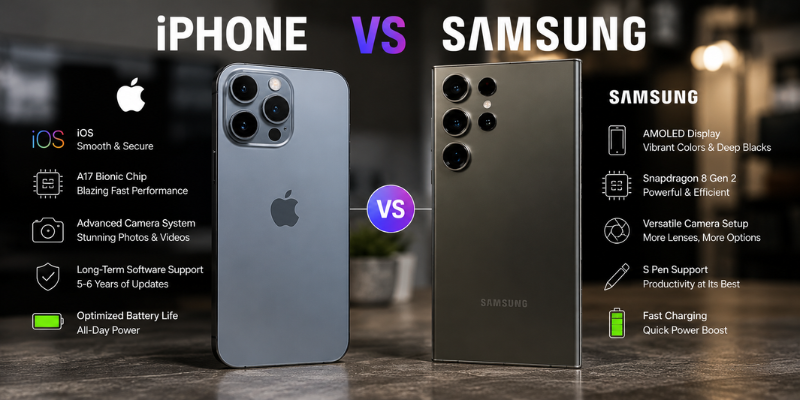
Choosing between an iPhone vs Samsung smartphone can be surprisingly difficult, especially when both brands offer powerful cameras, fast performance, premium designs, and long-lasting software support. While iPhone focuses on simplicity and seamless ecosystem integration, Samsung gives users more customization and hardware flexibility. In this guide, we’ll compare iPhone and Samsung across performance, cameras, battery life, software, design, price, and everyday usability to help you choose the phone that best fits your needs.
Design and Build Quality
Both Apple and Samsung have developed a reputation for premium smartphone design. Modern iPhones generally have a clean, recognizable appearance, while Samsung offers everything from conventional flagship phones to foldable models.
An iPhone tends to feel familiar from generation to generation. Its interface, button placement, and overall design are intentionally consistent. For someone upgrading from an older iPhone, the transition is usually effortless.
Samsung, meanwhile, experiments more aggressively with hardware. Its Galaxy lineup includes traditional flagship phones as well as foldable devices. This gives buyers more choice if they want something different from the standard smartphone design.
In practical terms, neither brand has a clear winner. If you prefer a straightforward premium phone, an iPhone is an easy choice. If you enjoy new hardware concepts and more variety, Samsung has the advantage.
Performance and Everyday Speed
Performance is another area where the iPhone vs Samsung debate gets interesting.
Apple designs its own processors and tightly integrates them with iOS. This combination allows iPhones to deliver excellent performance even when using demanding apps, editing videos, playing games, or switching between multiple tasks.
Samsung uses different processors depending on the model and market, but its high-end Galaxy phones are also extremely powerful. For everyday activities such as social media, streaming, photography, browsing, and messaging, both brands provide more than enough performance.
Where you may notice a difference is in long-term consistency. Apple has traditionally offered strong software support for older iPhones, which can make an iPhone attractive to people who keep their phones for several years.
Samsung has also improved its long-term update policy significantly, making newer Galaxy devices much more appealing for buyers who do not replace their phones frequently.
Camera Quality and Photography
For many buyers, the camera is one of the biggest reasons to choose one phone over another.
iPhones are particularly popular among people who want consistent results without spending much time adjusting settings. Colors, skin tones, video quality, and exposure are generally handled in a predictable way. Apple’s video capabilities are also a major selling point for creators and social media users.
Samsung takes a more feature-rich approach. Galaxy phones often provide multiple camera lenses, powerful zoom options, and a variety of shooting modes. Samsung’s image processing can also produce bright, punchy photos that look impressive immediately on a phone display.
Here’s a simple example: if you’re taking quick family photos at a birthday party, either phone can produce excellent results. But if you’re standing far away from a concert stage and want to capture the performer, a high-end Samsung Galaxy with strong zoom capabilities may give you more flexibility.
The best camera therefore depends on what you photograph—not just the megapixel count.
Battery Life and Charging
Battery performance varies considerably between individual models, so comparing brands alone can be misleading.
Samsung offers phones with different battery capacities and charging technologies, giving buyers several options. Some Galaxy models also provide features such as fast charging and wireless charging.
iPhones can deliver impressive battery endurance despite not always having the largest battery capacity on paper. Apple’s hardware and software optimization plays an important role here.
Your usage habits matter just as much. A person who spends hours watching YouTube, using navigation, taking photos, and playing games will naturally drain a battery faster than someone who mostly sends messages and checks email.
If fast charging and hardware flexibility are priorities, Samsung may appeal more. If predictable battery performance and tight hardware-software integration matter most, an iPhone remains a strong choice.
Software and User Experience
This is probably the biggest difference in the iPhone vs Samsung comparison.
iPhones run iOS, which is designed around simplicity and consistency. The interface is relatively straightforward, and Apple tightly controls the overall experience. This can be particularly useful for people who want a phone that works without requiring much customization.
Samsung phones use Android with Samsung’s One UI interface. Users get considerably more control over how the phone looks and behaves. You can customize the home screen, widgets, app layouts, multitasking features, and many other aspects.
Imagine giving the same phone to two different people. One may love the iPhone because they can sign in, transfer their data, and immediately start using it. Another may prefer Samsung because they can adjust almost everything to suit their personal workflow.
Neither approach is objectively better. It comes down to whether you value simplicity or flexibility.
Ecosystem and Connectivity
Apple becomes especially attractive when you already own other Apple products.
An iPhone can work closely with devices such as Macs, iPads, Apple Watches, and AirPods. Features that allow users to move between devices or share information can make everyday tasks feel seamless.
Samsung also has a growing ecosystem of phones, tablets, watches, earbuds, computers, and other connected products. Its integration with Android and Windows devices can be particularly useful for people who work across different platforms.
This is an important purchasing tip: don’t evaluate a smartphone in isolation.
If your home is already filled with Apple devices, moving to Samsung may require adjusting your habits. Likewise, someone deeply invested in Android and Windows may find Samsung the more natural choice.
Price and Overall Value
Price is another factor where Samsung offers significant variety.
Samsung sells phones across multiple price categories, from affordable Galaxy models to premium flagship devices and foldables. This means buyers can enter the Samsung ecosystem without necessarily paying flagship prices.
Apple’s lineup also includes different price points, but its brand positioning is more concentrated around premium devices.
The cheapest phone isn’t necessarily the best value. Consider how long you plan to keep the device, how much storage you need, whether you care about camera performance, and how important software updates are to you.
For example, spending more on a phone that remains useful for four or five years can make more financial sense than buying a cheaper device that you want to replace after two years.
Which One Should You Buy?
The easiest way to decide is to match the phone with your priorities.
Choose an iPhone if you:
- Want a simple and consistent user experience.
- Already use Apple products.
- Care strongly about video recording.
- Prefer long-term software support.
- Want reliable performance without extensive customization.
Choose Samsung if you:
- Want more customization options.
- Prefer Android.
- Like having different phone models and price points.
- Value camera versatility and zoom capabilities.
- Are interested in features such as foldable phones.
- Want greater flexibility with multitasking and device settings.
For someone buying their first premium smartphone, either brand can be an excellent investment. The more important question is which experience feels natural to you.
Frequently Asked Questions
Is iPhone better than Samsung?
Neither is universally better. iPhone is often preferred for its simple software, strong video performance, ecosystem integration, and consistent user experience. Samsung is attractive for customization, hardware variety, camera flexibility, and Android features.
Which has the better camera, iPhone or Samsung?
Both offer excellent cameras. iPhones are particularly strong for consistent photography and video, while high-end Samsung phones often provide more camera flexibility, especially for zoom and different shooting modes.
Which phone lasts longer, iPhone or Samsung?
Both can last for years when properly maintained. Software support, battery health, storage, physical condition, and how heavily the phone is used all affect its useful lifespan. Recent Samsung devices have also made long-term software support a stronger part of the buying decision.
Is Samsung cheaper than iPhone?
Samsung offers a wider range of prices, including affordable and mid-range Galaxy phones. Apple’s lineup is more concentrated toward premium pricing. However, the best value depends on the specific models being compared rather than the brands alone.
Should I switch from Samsung to iPhone?
Switching makes sense if you prefer Apple’s software experience or want closer integration with devices such as a Mac, iPad, or Apple Watch. If you enjoy Android customization and Samsung’s hardware features, staying with Galaxy may be the better option.
Conclusion
The iPhone vs Samsung debate doesn’t have one universal winner. Both brands deliver powerful phones, excellent cameras, strong displays, and capable software.
iPhone is a compelling choice for simplicity, consistency, video, and ecosystem integration. Samsung stands out for customization, hardware variety, and camera flexibility.
Before buying, think about how you actually use your phone every day. The best smartphone isn’t necessarily the one with the longest feature list—it’s the one that fits your habits.